If you are planning to prepare for the RRB NTPC exam but don’t know how to start, don’t worry. This guide is specially written for beginners. With the right strategy, study plan and practice, anyone can score good marks in RRB NTPC.
What is RRB NTPC?
RRB NTPC stands for Railway Recruitment Board Non-Technical Popular Categories.
Every year, Railways conduct this exam to recruit candidates for posts like:
• Clerk
• Typist
• Goods guard
• Station master
• Traffic assistant and many more.
This exam is very popular because the job is permanent, government-based and offers good salary and many other facilities.
RRB NTPC Exam Pattern (Simple Explanation)
The exam happens in different stages:
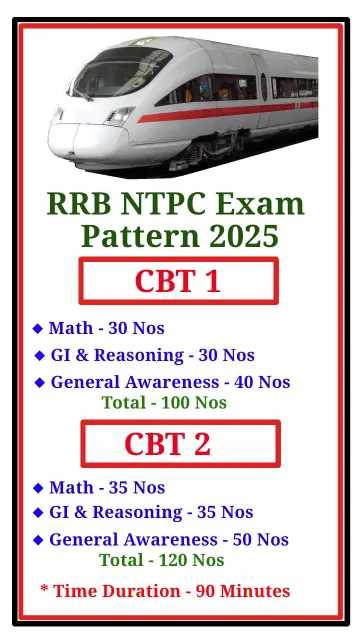
1. CBT – 1 (Computer Based Test)
• Questions: 100
• Time: 90 minutes
• Subjects: Mathematics, General Intelligence and Reasoning, General Awareness
• Negative marking: Yes (–0.25 mark for each wrong answer)
2. CBT – 2
• Questions: 120
• Time: 90 minutes
• Same subjects but questions are a little higher level than CBT-1
After clearing both, there are typing test / document verification depending on the post.
Syllabus for Beginners (Easy Breakdown)
Mathematics
• Number system
• Percentage & Profit-loss
• Time & Work
• Ratio & Proportion
• Simple interest & Compound interest
• Time, Speed, Distance
• Mensuration
• Algebra & Geometry basics
These chapters are very important come again and again. Focus here.
Reasoning
• Analogy
• Coding-decoding
• Series (numbers/letters)
• Puzzles
• Syllogism
• Blood relation
• Direction
• Ranking & Seating arrangement
Reasoning becomes easy with practice, not theory.
General Awareness
• Indian history
• Geography
• Polity
• General science (Class 6–10 level)
• Current affairs
• Railway related facts
General Awareness can give high marks in less time.
How to Start Preparation: Step-by-Step
• Start with basics – Use NCERT (6–10) for maths & science basics
• Make a daily timetable – At least 2–4 hours for beginners
• Practice every day – Without practice, math and reasoning becomes tough
• Give mock tests – It improves speed and accuracy
• Note down mistakes – Work on weak topics
Daily & Weekly Study Plan
Daily Routine
| Subjects | Times |
| Math | 1 hour |
| Reasoning | 1 hour |
| General Awareness | 1 hour |
| Mock Test / Practice Paper | 1 hour |
Then take rest and refresh yourself. Then repeat the circle entire day.
Weekly Target
• Complete 2–3 chapters of maths
• Practice 300+ reasoning questions
• Revise GK for 3–4 days
• Give at least 1 mock test
Best Books for RRB NTPC Preparation
Mathematics
• Kiran Publication (Chapter-wise solved papers)
• R.S Aggarwal – Quantitative Aptitude
• NCERT 6–10 basics
Reasoning
• A Modern Approach to Verbal & Non-Verbal Reasoning – R.S Aggarwal
• Kiran Publication Reasoning book
General Awareness
• Lucent GK
• Arihant General Knowledge
• Daily current affairs (newspaper / apps)
Why Previous Year Question Papers Are Important
• You will understand question pattern
• Many questions repeat
• You learn which topics are important
• It helps you manage time during exam
Try to solve at least 5–10 previous year papers.
Mock Test Strategy
• Start giving mock tests once basic syllabus is complete
• Try full-length tests every week
• After the test, check mistakes
• Improve accuracy and reduce negative marking
• Speed matters, but accuracy is more important
Common Mistakes Beginners Should Avoid
• Studying without planning
• Only reading theory, no practice
• Ignoring general awareness
• Not revising notes
• Not checking mistakes
Tips for Working / College Students
• Study 1–2 hours daily
• Use weekends for revision
• Watch short video lectures to save time
• Practice math & reasoning during free breaks
• Read current affairs for 10–15 minutes daily
Revision Strategy
• Make short notes of formulas
• Keep a small notebook for GK facts
• Revise once every week
• In the last one month, solve more tests than theory
Last 30 Days Preparation Plan
• Daily full-length mock test
• Revise weak topics
• Learn important GK and current affairs
• Practice calculation tricks for speed
• Avoid learning new topics at the last moment
Motivation for Beginners
Many students crack RRB NTPC in the first attempt.
You don’t need 10 hours of study—just consistent study and smart practice.
Start small, but stay regular. Even 2–3 hours daily is enough if you follow a plan.
Final Words
RRB NTPC is a great opportunity, and beginners can easily crack it with the right approach.
Start with basics, practice regularly, give mock tests, and stay focused.